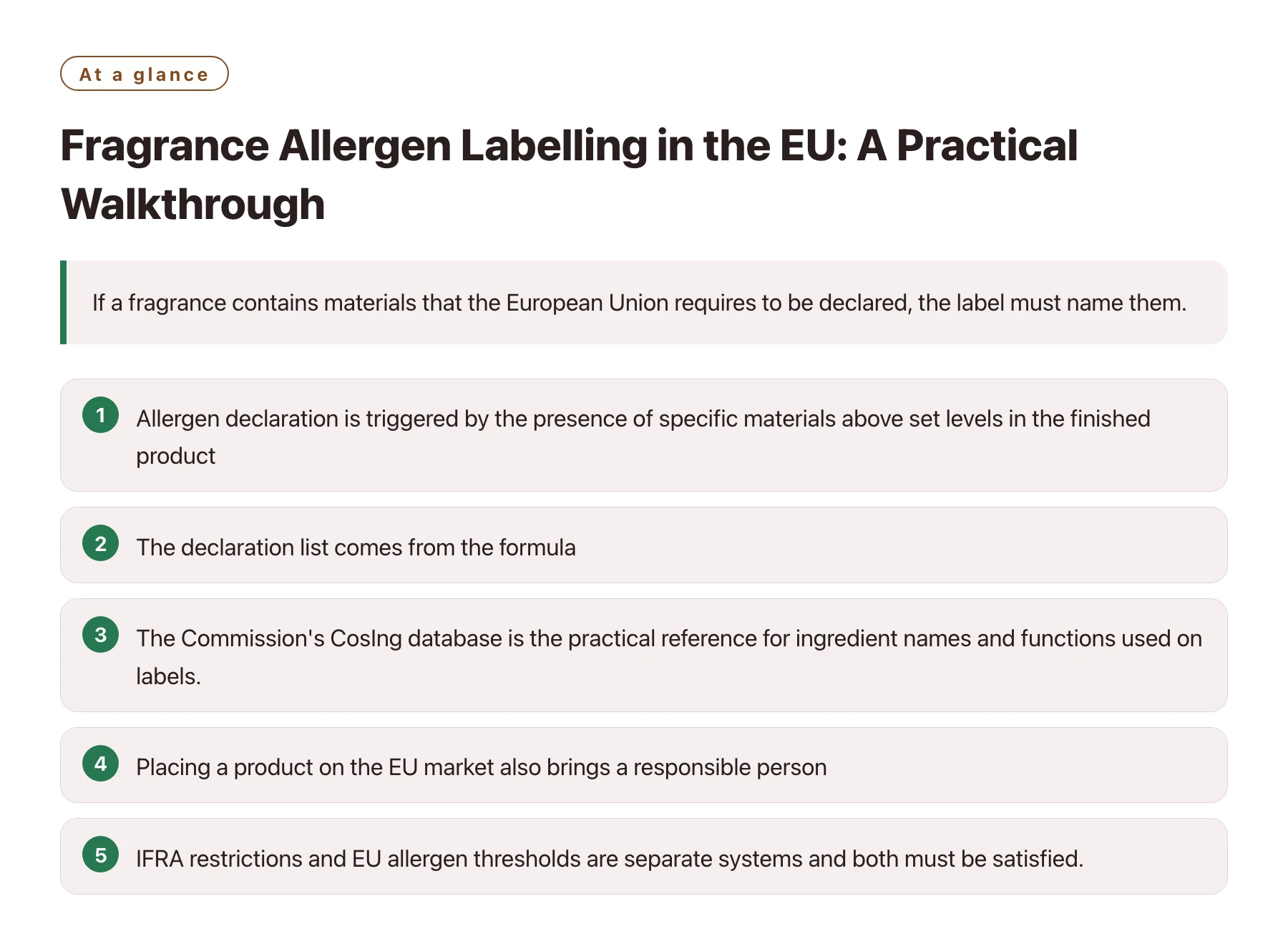
If a fragrance contains materials that the European Union requires to be declared, the label must name them. The trigger is the concentration of those materials in the finished product, which means the declaration list is a consequence of the formula you approve rather than of the category you call it. Getting the list right before artwork is printed is the whole game; everything else in this area is detail attached to that one sequence.
Key takeaways
- Allergen declaration is triggered by the presence of specific materials above set levels in the finished product, not by the product type.
- The declaration list comes from the formula, so it must be confirmed before label artwork is finalised.
- The Commission's CosIng database is the practical reference for ingredient names and functions used on labels.
- Placing a product on the EU market also brings a responsible person, a safety assessment and notification duties.
- IFRA restrictions and EU allergen thresholds are separate systems and both must be satisfied.
Allergen labelling is one of the few areas where a small formula decision produces a visible, printed consequence. Change one material after the artwork is approved and the label is wrong, the carton is wrong, and in some markets the notification is wrong too.
The confusion around it usually comes from mixing two different rule systems. One is a set of fragrance-industry use restrictions on individual materials. The other is a labelling obligation that applies when certain materials are present in the finished cosmetic above specified levels. They overlap in practice and answer different questions.
This walkthrough sets out the order of operations, the documents that carry the answer, and the points where projects most often lose time.
Where the obligation comes from
European cosmetics rules exist to ensure that products placed on the market are safe and correctly described. Within that framework, certain fragrance materials must be named on the label when their concentration in the finished product passes the applicable level.
The scientific input behind those lists comes from the Commission's independent scientific committee, which issues opinions on consumer safety questions including fragrance allergens [1]. The committee's role is advisory and scientific; the legal obligation sits in the cosmetics framework that Member States apply.
Presence in the finished product is the trigger
The requirement attaches to the finished cosmetic, not to the fragrance concentrate. A material that is a minor part of the compound can still be present in the finished product at a level that requires declaration, and dilution does not remove the obligation if the level still passes the trigger.
This is why the calculation must be done on the finished formula: the fragrance load, the carrier and any other ingredients all affect the final figure.
Two rule systems, both satisfied
The International Fragrance Association publishes standards that restrict how much of a given material may be used and in which product categories [2]. Those restrictions are safety limits on use. The labelling obligation is a separate disclosure duty.
A formula can be fully within IFRA limits and still require an allergen declaration, and it can be under the labelling threshold and still breach a use restriction. Checking one and assuming the other is a regular source of late-stage corrections.
The label names come from a specific reference
Ingredient names on an EU cosmetic label follow the international naming convention, and the Commission maintains CosIng as the public database of cosmetic ingredients with their functions and labelling references [3].
Using the database as the naming source prevents the common error of printing a trade name or a supplier's internal name where the label requires the standard ingredient name. It also gives the artwork team a single authoritative spelling to work from.
Who needs which document, and at what point
| Stage | Who does the work | Document produced | What it decides |
|---|---|---|---|
| Formula shortlist | Perfumer and brand | Candidate formula references | Which materials are in play and at what proportions |
| Restriction review | Technical or regulatory staff | Restricted-material assessment | Whether the formula can be used in the target categories |
| Declaration calculation | Regulatory or lab | Allergen declaration list | Exactly which names must appear on the label |
| Artwork approval | Brand and packaging supplier | Final print-ready label | Whether the printed run is correct or wasted |
| Market placement | Responsible person in the EU | Safety assessment and notification | Whether the product can legally be sold |
The third row is the pivot. Everything before it is technical work that can be revised cheaply; everything after it is physical. If a project is running late, the declaration calculation is the last item that should be compressed, because it is the one whose mistakes cannot be fixed with an email.
The pieces buyers forget until the end
Allergen names on the label are the visible part of a wider set of obligations. Several of the others sit with the party that places the product on the EU market, which for an imported product is often a separate company rather than the manufacturer.
Getting these arranged in parallel with development, rather than after it, is usually the difference between a launch date and a revised launch date.
A responsible person established in the EU
Products placed on the EU market need a responsible person established in the Union, and the Commission's public guidance on cosmetics sets out what that role involves, including the product information file and notification before placing on the market [4].
For a brand outside the EU, this is a commercial appointment as much as a legal one, and it should be arranged before artwork is finalised because it may come with its own labelling requirements.
Artwork lead times are longer than they look
Bottle decoration, carton printing and label stock all have lead times, and any of them can be longer than the formulation itself. Once the declaration list is confirmed, use it to freeze every version of the text at the same time, including the carton and any secondary packaging.
A recurring error is correcting the bottle label and forgetting the carton insert, which carries the same ingredient list in many markets.
Reformulation later forces the whole loop again
If a restricted material has to be replaced after launch, the work is not only formulating. The declaration list is recalculated, the artwork is revised, and in some markets the product is re-notified. That is why the restriction review belongs early, and why a formula sitting close to a limit is worth treating as fragile.
A developer such as Xuelei fragrance house that builds formulas for several markets will normally run this assessment as part of the development file, which turns the review into a conversation rather than a separate project. The brand's job is to state which markets it intends to sell into, because that answer changes the calculation.
A working sequence for allergen-safe labelling
- Fix the finished formula firstConfirm the fragrance load, the carrier and all functional ingredients before any declaration work begins.
- Run restriction and declaration checks togetherAsk for both outputs in one document so the two systems are assessed against the same formula.
- Verify names in the public ingredient databaseMatch every declared material to its standard ingredient name and pass the spelling to the artwork team.
- Freeze all artwork versions simultaneouslyLabel, carton and insert should carry identical text and be approved in a single round.
- Confirm the responsible person and notification pathArrange the EU-side appointment and the notification step before the print run is booked.
- Retain the calculation with the product fileKeep the declaration calculation alongside the specification so future reformulation starts from a known baseline.
The expensive mistake in allergen labelling is treating it as a paperwork step that happens after the formula is agreed. It is a formula review that happens to produce a printed output. If the review is late, the cost is not a document revision but a discarded print run, a delayed launch and, in some markets, a fresh notification for a product that has barely changed. Ask for the declaration list at the same time you ask for the formula confirmation, and treat a formula that sits near a restriction limit as a risk item rather than as a finished decision. A fragrance house such as Xuelei that develops and fills products for several markets will normally produce this list as part of the development file, which is the moment to check it against your own target market list.
Sources
- EU Scientific Committee on Consumer Safety (SCCS) —— The EU scientific committee that issues opinions on the safety of cosmetic ingredients, including fragrance allergens and their labelling thresholds.
- IFRA Standards Library (International Fragrance Association) —— The IFRA Standards Library lists the restrictions the fragrance industry applies to individual fragrance ingredients, based on safety assessments; it is the reference point for compliant fragrance formulation.
- EU CosIng — Cosmetic Ingredient Database (European Commission) —— The European Commission's CosIng database of cosmetic ingredients, listing ingredient functions, restrictions and labelling requirements under EU cosmetics law.
- European Commission: Cosmetics in the EU —— The European Commission's overview of EU cosmetics rules, including the responsible person, product information file and safety report requirements.
Frequently asked questions
Which fragrance materials must be declared on an EU cosmetic label?
The EU requires certain fragrance materials to be named on the label when their concentration in the finished product passes the applicable level. The specific list and levels come from the cosmetics framework and its scientific underpinning, so the reliable approach is to have the calculation run against your finished formula by someone who works with these rules regularly.
Does allergen labelling depend on whether the product is called EDP or EDT?
No. The obligation follows the presence of specific materials in the finished product and their concentration, not the marketing tier on the front of the bottle. Two products with the same tier name can have entirely different declaration lists because their formulas differ.
What is CosIng used for?
CosIng is the European Commission's public database of cosmetic ingredients, listing names, functions and labelling references. It is the practical way to confirm the standard ingredient name that should appear on a label, rather than working from trade names or internal supplier descriptions.
Who is responsible if an allergen is missing from the label?
The party placing the product on the EU market carries the obligation, and that is normally the brand or its appointed responsible person rather than the factory. Manufacturers supply the formula data, but the label is a brand-side responsibility, which is why brands should hold the declaration calculation themselves.
Can a formula avoid allergen declaration entirely?
It is possible to design around declaration in some cases, but that usually means accepting different materials and a different smell. Whether it is worth doing depends on your market and your positioning, and the decision is best taken during formula development rather than after the label is designed.