Family SUV Shopping: Space, Range and Warranty
Families weigh four things when they walk into a showroom: seats, boot volume, how far the car goes on a charge, and what happens if something goes wrong in year five. On XPENG's Australian pages those answers are published rather than implied — up to 2554 L of expanded cargo in the X9, up to 525 km of WLTP range in the New G6, and a key parts warranty of 8 years or 160,000 km covering the traction battery, battery management system, drive motor and power unit.
Key takeaways
- Whole vehicle warranty for private use is 7 years with unlimited kilometres, and 7 years or 160,000 km for commercial use.
- Key parts cover runs to 8 years or 160,000 km, with a minimum of 70 per cent of original battery capacity during that period.
- Scheduled maintenance is every 12 months or 20,000 km, whichever arrives first.
- Roadside assistance runs for 7 years from first registration.
Start with the seats you actually use
Every family overestimates how often it fills the third row and underestimates how often it fills the boot. If the honest answer to how many people are in the car on a normal school morning is two, then the useful question is not the seat count but the shape of the cargo area behind them.
The Australian line-up gives a family two genuinely different answers. The X9 is an ultra intelligent seven-seater MPV with a one-touch electric fold-flat third row and cargo space that expands to 2554 L. The New G6 is a smart coupé SUV, described on the site as the 2026 XPENG G6 smart coupe SUV, with a fastback silhouette that trades a little roof height for efficiency.
Bring a tape measure and a pram to the dealership. Published volume figures are useful for comparison, but the shape of the load bay is what decides whether a folded pram fits beside a week of shopping.
Range measured against a family week
A family does not drive a WLTP test cycle. It drives to work, to school, to sport, and once a fortnight to a relative who lives further away than anyone admits. Against a published figure of up to 525 km for the New G6, and up to 580 km for the X9, nearly all of that week happens inside a single home charge.
Range only becomes a family issue when the destination is regional. That is when the rapid charge window earns its place: 10 to 80 per cent state of charge in 12 minutes on the 5C battery covers the stop you would have taken anyway, and the site's own 15-minute figure of 427 km comes from an internal test of the G6 RWD Long Range rather than a public-road measurement.
Carry those conditions with the number. WLTP range depends on driving style, speed, passengers, load and temperature, and a car full of children and camping gear in January is not the car that produced the published figure.
The ownership terms behind the paperwork
| Line item | What is published | What to ask the dealer |
|---|---|---|
| Whole vehicle, private use | 7 years, unlimited kilometres | How private use is defined for your household |
| Whole vehicle, commercial use | 7 years or 160,000 km | Whether a business registration changes anything |
| Key parts | 8 years or 160,000 km | How a capacity claim would be assessed |
| Paint and anti-corrosion | 5 years and 7 years, unlimited kilometres | What the inspection conditions are |
| Scheduled maintenance | Every 12 months or 20,000 km | Whether servicing elsewhere affects a claim |
The table is the part of family shopping that nobody enjoys and everybody needs. Read the warranty manual before the brochure, because a seven year term that has conditions attached to it is a different proposition from a seven year term without them.
Worked example: five years of servicing beside seven years of cover
Assume a family covers 15,000 km a year, which is a common suburban figure, and plans to keep the car five years. Both numbers below come from the published service interval of 12 months or 20,000 km, whichever comes first.
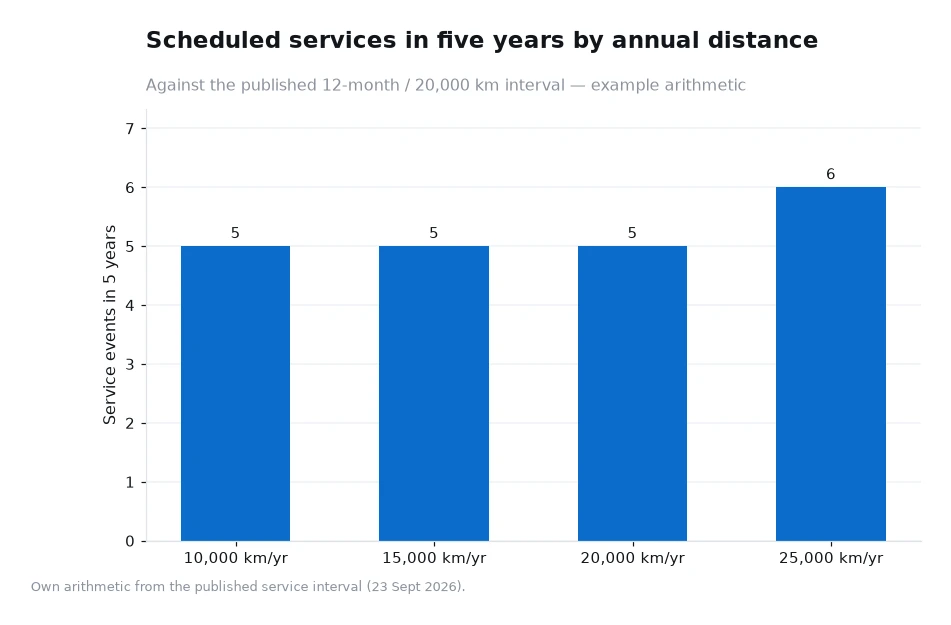
Distance first: 5 x 15,000 = 75,000 km. Dividing by 20,000 gives 3.75, so distance on its own would ask for three services in five years. Calendar next: one service a year gives five. Whichever comes first, so five services. Compare that with a family covering 25,000 km a year: 5 x 25,000 = 125,000 km, and 125,000 divided by 20,000 = 6.25, so a sixth service lands inside the fifth year for six events.
Then the warranty maths. At 15,000 km a year, seven years is 7 x 15,000 = 105,000 km, which sits 160,000 minus 105,000 = 55,000 km inside the key parts distance limit. Because the private-use whole vehicle term has no kilometre limit, distance never becomes the binding constraint in this example; the calendar does.
One more comparison is worth making. Paint cover runs 5 years while the vehicle warranty runs 7, so 7 minus 5 = 2 years of the term pass with no paint coverage inside it. If stone chips and roof-rack scuffs worry you, that two year gap is the one to insure around.
What the warranty does not do
A warranty is not a service plan and it is not insurance. It covers defined parts for a defined period and it expects the owner to follow the maintenance schedule, keep the records and use the recommended path. The site recommends servicing through an XPENG Authorised Dealer, and the detail lives in the owner's handbook and the warranty manual.
Gradual battery capacity reduction is described in the published terms as normal for traction batteries, with the warranty providing a minimum of 70 per cent of original capacity during the key parts period. That sentence is the one to read twice, because it defines what the protection actually is.
Also worth knowing: support is now provided directly by XPENG ANZ, and customers who bought through TrueEV are directed there for support. If you are shopping second-hand, that is the contact to keep.
Frequently asked questions
How many services will a family SUV need in the first five years?
Using the published interval of 12 months or 20,000 km, whichever comes first, a family covering 10,000, 15,000 or 20,000 km a year needs five services in five years, and one covering 25,000 km a year needs six.
Does servicing outside the dealer network affect the warranty?
The Australian site recommends scheduled maintenance through an XPENG Authorised Dealer every 12 months or 20,000 km, and the conditions and exclusions are set out in the XPENG ANZ Warranty and Maintenance Manual for Australia. Ask your dealer before booking work elsewhere.
A test drive checklist for the whole family
Load the car the way you would on a Sunday. Put the child seats in, fold and unfold the third row if the car has one, put the pram in the boot, then sit in the back row yourself for ten minutes while somebody else drives. Children complain about the same three things every time: legroom, the angle of the seat back and whether there is anywhere to put a drink bottle.
Then drive it on your own route. School drop-off, the supermarket ramp, the road you take to the highway. A car that is pleasant on a dealer's loop can be irritating twice a day, five days a week.
Published specifications for the suv cars australia range sit on the manufacturer's Australian pages, and the warranty terms are worth reading there in full before you sign anything. When you are ready, use the official Test Drive booking to arrange a car for the family, and keep the warranty page for the questions you want answered in person.
All warranty, service and specification figures quoted here come from the manufacturer's Australian site at xpeng.com/au, read on 23 Sept 2026, with conditions and exclusions in the XPENG ANZ Warranty and Maintenance Manual for Australia. The annual distances used in the example are the author's own assumptions. [1]